Materiality Identification Process
Under our corporate philosophy of "sowing the seeds of joy," we identify material issues to achieve both sustainable growth and the resolution of social challenges.
This process is implemented as a mechanism directly linked to our business strategy, medium-term business plan, and KPIs, while referencing international frameworks (GRI, SASB, TCFD, TNFD, etc.) and standards set by external evaluation agencies.
We also ensure transparency and accountability through governance by the Board of Directors and the Sustainability Committee, combined with reviews by external experts.
Step 1: Understanding the External Environment and Social Issues
We regularly collect and analyze information on policies and regulations (e.g., carbon neutrality, Plastic Resource Circulation Act), scientific findings (IPCC reports, natural capital data), industry benchmarks (trends in cleaning, food service, retail), and expectations from ESG rating agencies and investors, to identify risks and opportunities.
Step 2: Stakeholder Engagement
We conduct fan meetings with consumers, consumer roundtables, franchisee meetings, employee awareness surveys, and one-on-one meetings with investors. Feedback gathered is organized by theme and scored.
Step 3: Extracting and Screening Candidate Themes
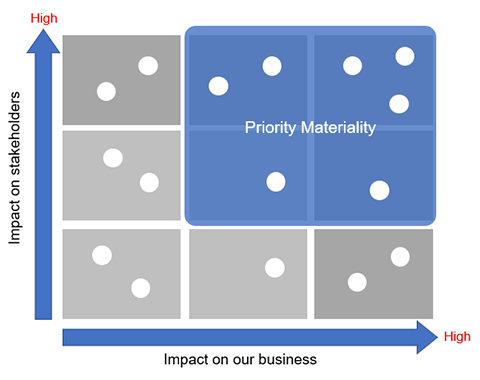
Risks and opportunities are initially assessed using a two-axis framework: "Impact on stakeholders" and "Impact on our business." Candidate themes are then screened by external experts.
Step 4: Developing the Materiality Matrix
After plotting candidate themes on a two-axis matrix, they are classified into High, Medium, or Low importance. Those in the upper-right quadrant—high on both axes—are identified as Priority Materiality.
Step 5: Setting KPIs and Integrating into Strategy
For each identified material issue, we set short-term (up to 3 years) and medium-term (through 2030) KPIs aligned with our Duskin Green Target 2030 and Medium-Term Business Plan 2028.
- Examples:
- • Customer-level sales: 491 billion yen by fiscal year ending March 2028
- • CO2 emissions: 46% reduction by 2030 (t-CO2 basis)
- • Ratio of female managers: 30% by 2030
- • Investor engagement: 100+ meetings annually
Step 6: Approval and Disclosure
After deliberation by the Sustainability Committee and final approval by the Board of Directors, materiality is disclosed through our Integrated Report and website.
Step 7: Monitoring and Review
Progress on KPIs is monitored semi-annually and reported to the Sustainability Committee. Results are disclosed annually in our Integrated Report, along with achievement levels and challenges. Reviews are conducted as needed in response to environmental changes or social demands (e.g., regulatory tightening, natural disasters).