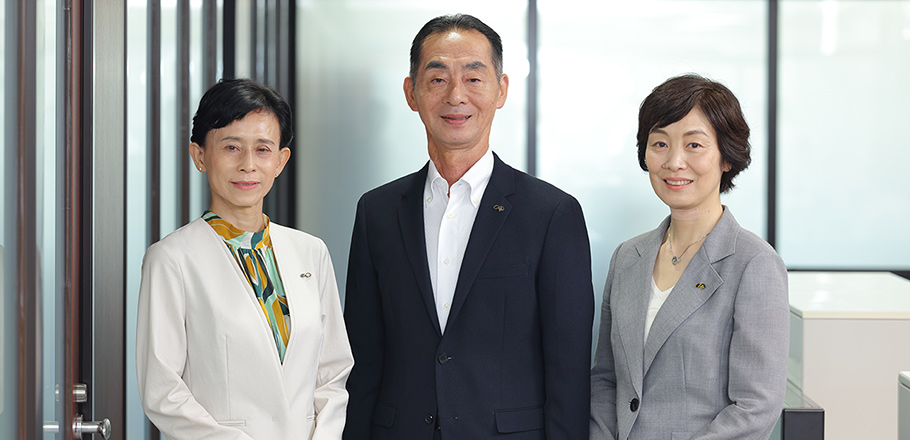
- Fumi Musashi
- Outside Director
- Rie Nakagawa
- Outside Director
It is a top of the page.
Musashi: I think an outside director's most important role is to contribute to raising corporate value over the medium and long term. I was appointed a Duskin Outside Director in June 2022, and rather than fall into a mindset that over-emphasizes short-term results, I have tried to fulfill my role as a monitor with a focus on sustainable growth. In addition, I try to contribute to the company in an advisory role in the area of overseas transactions and the like by leveraging my years of experience at a trading company.
An Outside Director not only objectively evaluates how to minimize and avoid risk, he or she also needs to ascertain how much risk is acceptable and encourage taking risks. When the Board of Directors has deliberated on new M&A proposals over the last three years, I think we assumed an appropriate level of risk when making decisions.
The Outside Directors and Outside Audit and Supervisory Board Members regularly convene the Outside Directors and Audit and Supervisory Board Members Council, and since half of its members were newly appointed last fiscal year, we took the opportunity to have an energetic discussion from a variety of new perspectives. This fiscal year I was appointed chairman of the Nominating and Compensation Committee, and in that role, I am also working on the CEO succession plan and the Board Director and Operating Officer evaluation system.
Nakagawa: I understand that an Outside Director is expected to contribute to a sustainable improvement in corporate value as someone who always represents the views of minority shareholders. I was appointed an Outside Director very recently, in June 2024, and in my previous position I was involved in strategic planning and business operations from an operating officer perspective.
Using this background, I have observed the workplace in a variety of settings to more thoroughly understand Duskin's strengths and challenges, and I have also greatly deepened my understanding of the franchise business model. Looking ahead I hope to fulfill my role as an Outside Director in a way that contributes to further enhancing corporate value while also identifying both what we ought to change and the values that we ought to preserve.
Nakagawa: In terms of how the Board of Directors operates, I feel that its deliberations tend to focus more on the operational aspect of the business and that the roles of business operations and business supervision are not necessarily clear. Looking ahead, I think strengthening governance will require reorganizing the roles and management approach of meeting bodies, delegating authority to the business operation side, and, for the Board of Directors, increasing the amount of discussions that take a medium- to long-term perspective.
Moreover, regarding the Outside Directors' monitoring role, Outside Directors and Audit and Supervisory Board Members Council meetings serve as a meaningful forum for making governance more effective because they can provide us with a common awareness about certain issues. As a result of our suggestion that there should also be opportunities to engage in this kind of dialogue with the operational side, this fall the Outside Directors and Operating Officers will gather together for an offsite meeting. I hope that such a venue will allow for substantive discussion concerning topics that cannot be thoroughly explored at Board of Directors meetings.
Musashi: Regarding the operation of the Board of Directors, the Secretariat, which serves as the Board's administrative office, and Corporate Planning, which performs a cross-sectional function across the entire company, will collaborate and take the lead in setting the Board's annual agenda. We expect matters that ought to be delegated to the operational side and important matters that need to be taken up and discussed by the Board of Directors to be clearly distinguished in accordance with the Board of Directors regulations and be appropriately reflected in the agenda.
Moreover, at the biannual Business Strategy Meetings, we have arranged an opportunity this year for just the Board of Directors members to engage in strategic discussions, and I am convinced that this along with the offsite meeting scheduled for this fall can provide solid progress toward enhancing the effectiveness of the Board of Directors.
Musashi: The Long-Term Business Policy Do-Connect maintains continuity with its predecessor, ONE DUSKIN, yet takes an even more strategic approach. I think it has great potential. Moreover, the three directions advocated by the Medium-Term Business Plan 2028 — namely, "Explore, Expand, Excel" — as well as the business strategy and human resources strategy are also clearly articulated, thus ensuring strategic consistency.
An important item going forward will be how to consistently attain quantitative targets grounded on diligent implementation of KPI based on the logic tree. The Board of Directors as well will closely monitor the progress toward attaining quantitative targets.
Nakagawa: The Long-Term Business Policy Do-Connect was formulated through a bottom-up process initiated by a project led by mid-level employees. This approach allowed us to clearly define the direction that our company should take while also incorporating perspectives from the business front lines, and I highly value that aspect. On the other hand, the relation between the value creation process and the six capitals framework, as well as the strategic orientation for rebuilding the business portfolio and the time frame for doing that, all need to be made more specific. Besides simply putting together the numbers for each business division, investment decisions and capital allocation priorities need to be clearly articulated from a company-wide perspective.
Duskin has built a solid competitive edge with its Clean Service businesses centered on mat and mop rentals, but in more recent years Mister Donut has grown to become one of the main pillars for profits for the company. The company's business is made possible by the entirety of its own business ecosystem — the Duskin franchise network. With a big-picture grasp of the profitability of this overall structure and risk structure, while carefully watching the changing business environment, we will need to continuously deliberate on and monitor rebuilding the business portfolio into one as it should be in the future.
 Musashi: I believe that transforming and optimizing the business portfolio is an important topic for the Board of Directors in terms of enhancing corporate value in the medium and long term. There has been a certain amount of progress on expanding business domains through M&A, but going forward the question will be how best to efficiently and strategically allocate limited corporate resources. In particular, we need to continue more substantive and in-depth deliberation from the perspective of which business domains should be the main recipients of corporate resources and which business domains should be the object of focus and reorganization.
Nakagawa: I believe our company's direction of addressing social issues as well as our franchise-based business model will continue to function effectively going forward. But as the decline in population further accelerates in Japanese society, how the company coexists with that society and how it establishes a presence as a company that supports local communities will become increasingly pressing questions.
Given these structural issues, we want to reevaluate the sources of the company's competitive advantage and engage in constructive deliberations in an effort to achieve a sustained increase in corporate value.
Musashi: Among Duskin's corporate management challenges, I can cite speeding up the pace at which business is conducted and maintaining a steadfast commitment to achieving KPI targets. The Board of Directors as a body shares a focus on capital costs and the balance sheet, but we still find examples on the field level where employees are not fully aware of the importance of balance sheet figures, including inventory and inventory turnaround, and capital costs. In terms of key products and services, what is required is comprehensive cost optimization, incorporating inventory control based on lifecycle costs and consideration for disposal costs. I want to contribute to efforts that instill this perspective throughout the company and encourage employees to adopt a different way of thinking.
Musashi: The long-term growth of the domestic market is hard to predict amid increasing uncertainty, so I think further expanding business overseas will become even more important. The full-scale expansion of overseas business absolutely requires a thoroughly planned out investment of resources, including human resources, and establishing a strategy with a medium- to long-term time frame.
At the same time, there are also numerous ways to promote growth domestically, such as raising awareness of brands, with a focus on rising inbound tourist demand.
Duskin's nationwide franchise network is an exceedingly valuable intangible resource for the company. Very few companies possess such a resource. Even amid the increasing uncertainty brought about by a changing societal structure and economic environment, I expect Duskin to leverage the strength of this network toward solving issues in communities and creating new business opportunities. I, too, intend to contribute to this effort in my role as an Outside Director.
 Nakagawa: There are not many companies that have the same deep reach to consumers at the household level as Duskin. Given that the household structure in Japanese society is undergoing significant changes, the approach we presented in our Do-Connect business policy — solving social issues — truly embodies the Duskin company identity.
Going forward, as we further amplify the company's strengths and improve upon its weaknesses, we will remain committed to our all-out effort to enhance company value. We intend to continue working hard on providing our stakeholders with products and services that are even more delicious and even higher in quality.